Showing posts with label advertising. Show all posts

Tuesday, April 19, 2011

We love our products--more than we love other humans

So piggybacking on the speech by author Jean Kilbourne I linked at the end of my last post, I'd like to talk about the interesting and frightening concept Kilbourne presents us with.  This idea is the prepping of our society to be lifelong consumers through forming strong relationships with their products...stronger than their relationships with other human beings.

We see this in advertising a lot--the humanizing of inanimate products.  Frequently it is sexual.  Other times, though, our product is presented to us as a lifelong companion; something that is simple, and can be trusted...unlike humans.

For the men, we see this a lot in car or beer ads.  Example:
"Warning:  This vehicle may give you personal freedom"

"The ultimate attraction."

These are both car ads, obviously geared toward men.  The first is for Ford, selling us "personal freedom"--freedom from romantic obligations, most likely freedom from our significant other.  Ford is saying to us, "Hey men, buy this car as a way to escape your partner you loathe spending time with!"  After all, the car is faithful.
The second ad is for BMW, sexualizing the car more.  In my opinion, this is just creepy.  I mean really, they're selling you on having sex with your car...isn't that a little weird?  Anyway, the message behind this advertisement is pretty obvious-- "Your lover might let you have sex with her, but we know you really love your BMW so much more than this sex!"  Shudder.

So what about women?  Well, they're prepped in the same way, pretty much.  Chocolate ads/dessert ads are a pretty good example:

"Six Pack that melts a girl's heart.  Dove chocolate"
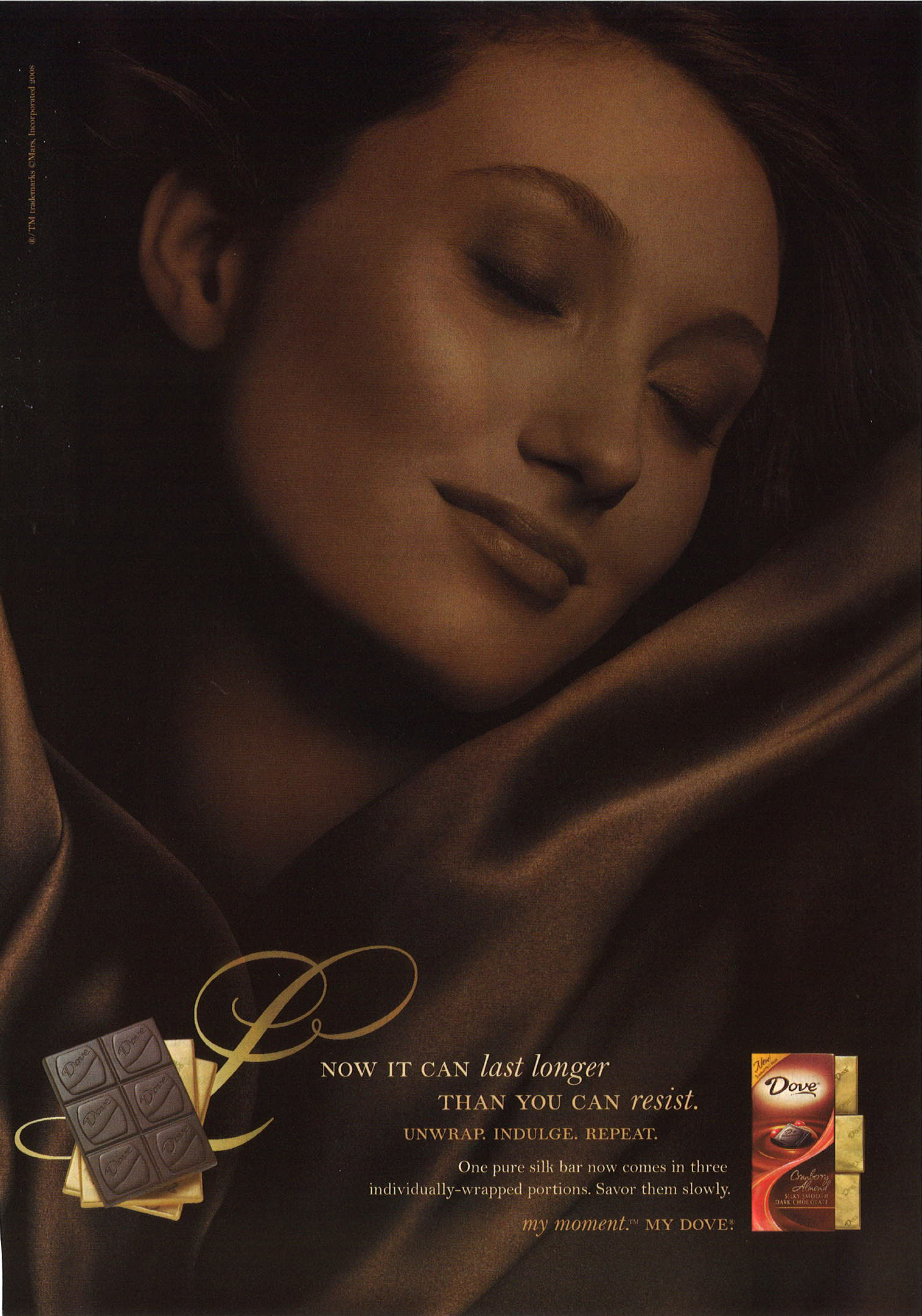
"Now it can last longer than you can resist.  Unwrap.  Indulge.  Repeat.  One pure silk bar now comes in three individually wrapped portions.  My moment.  My Dove!"

"You've never been caressed like this before."

The first two ads are for Dove chocolate.  
The first is selling us on the chocolate being comparable to a perfectly sculpted set of male abdominals.  Because of course, if you can't find a man who looks like a model or a body builder, you can just eat chocolate instead!  It'll make you feel better.
The second Dove chocolate ad is, just like the car ad we looked at, sexualizing the chocolate.  When you think about it that way, it seems so strange, doesn't it?  This Dove chocolate ad is saying to us that the chocolate will tease us until we can't handle it anymore, and then some.  This chocolate will never disappoint you with a performance problem!  This chocolate lasts for a long time...
The third ad is for Caress brand products.  Here, Caress is promising to touch us in a way incomparable to that of a human.  These products are better than human.  

More:


Sunday, April 10, 2011

Dolce and Gabbana - overtly sexist?

We live in a culture that has gone from sexual oppression and repression, to over-exposure to the point of desensitization within only 100 years time.  In a complicated western world complete with third wave, and post-feminism, the lines between pornography and many other media outlets (especially advertising) have become greatly blurred.  

Such is the case with the increasingly controversial advertising campaigns of the well-known fashion label, Dolce and Gabbana.
Dolce and Gabbana has been only been around since 1984*, and is already one of the most worn high-end clothing labels today.  D&G's ads can be seen in virtually almost every fashion magazine on the shelves, plus every issue of Vogue (the sort of king of the fashion magazine world).  People pay thousands of dollars for their clothing.  Its name has that kind of weight.

Now don't get me wrong, many companies use sex as a selling point in their advertising.  After all, it's easy to appeal to an irrational desire as strong as sexual desire.  Many companies also try to use controversy to "push the envelope," so to speak, in their advertising as a way to grab attention and generate buzz.  This is all fine and well to a certain extent, and sure, controversial advertising is always bound to offend someone one way or another.  But when does oversexualized, controversial advertising cross that line into blatant displays of sexism?

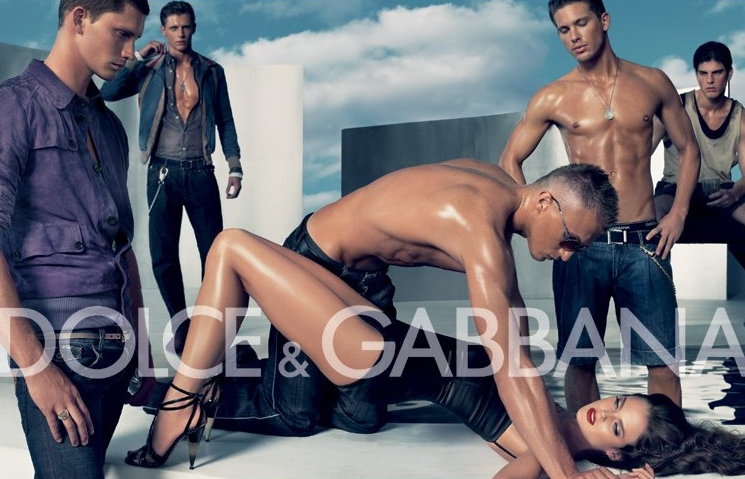
Here is probably the most infamous D&G ad, in that regard:

Of course, along with this ad came the two-sided argument of harm vs. harmlessness.  But there are a couple of important contextual elements to note.
For one, this ad was first released in the March 2007 issue of Esquire magazine.  In case you don't know what Esquire magazine is, it is a men's magazine that is published globally.
In addition to this, during the same time, Spain was experiencing a high rate of women targeted violence .
Both the Spanish and the Italian governments both demanded D&G pull the ads from their countries.  And that they did.

This next ad may look familiar from my last post:

When observing advertisements, we must look carefully and ask ourselves--what is this company trying to sell to us?  Who are they trying to sell to?  And what idea are they trying to sell us on?
If Dolce and Gabbana are trying to sell us on controversy, couldn't they do so in a million ways other than trying to sell rape and objectification of women?

More links on D&G ad controversy:
adpunch.org
Models and Moguls
Frisky Geek
Fashionist